AccessKeeper as the foundation for Zero Trust
Reading time: 6 minutes
Modern IT security concepts must do significantly more than traditional user management or securing a network perimeter. Today, companies operate in hybrid infrastructures, use cloud services, integrate external partners, and manage an ever-growing number of user accounts, machine identities, and privileged accesses. In this environment, it is no longer sufficient to grant trust once and for all. Security must be organized in an identity-centric, dynamic, and traceable manner. This is precisely where Zero Trust, Identity & Access Management (IAM), Privileged Access Management (PAM), and Continuous Verification come together. With AccessKeeper, RISE’s IAM solution, these requirements can be translated into a robust and practical security architecture.
Why Identities Are at the Heart of IT Security Today
In modern IT environments, identity has become the central control point. Security is no longer determined solely by networks, firewalls, or locations, but primarily by the question of which person, system, or service is permitted to access which resource. User accounts, roles, API access, service accounts, and administrator privileges directly determine how secure or vulnerable an infrastructure actually is. Incorrect or excessive permissions quickly lead to security gaps, compliance violations, and uncontrolled risks.
Furthermore, permission structures in many companies have evolved over time. Employees change roles, external service providers require temporary access, and technical accounts are often reused for years. Without a centralized system to manage and control these identities, a confusing web of permissions and exceptions emerges. This is precisely why structured Identity & Access Management is not just an organizational advantage today, but a core component of security strategy.
Zero Trust: No Access Without Verification
Zero Trust is based on the principle that no user, device, or system is considered trustworthy by default. Every access request must be explicitly verified, evaluated in context, and limited to the necessary minimum. This model is a direct response to modern IT realities, where employees work remotely, applications run across multiple environments, and attacks increasingly occur via compromised accounts rather than through open network interfaces.
For companies, Zero Trust represents a shift in perspective. Trust is not determined by a user’s position within the network, but rather by the combination of identity, role, context, and authorization requirements. A user should not be allowed to access sensitive resources simply because they are “on the internal network,” but only if their identity is clearly verified, their authorization is transparently granted, and their access is legitimate within the current context. For Zero Trust to work in practice, however, a system is needed that manages these identities and rights in a clearly structured manner. This is precisely where IAM becomes the operational foundation.
Identity & Access Management with AccessKeeper as the Foundation
Identity & Access Management ensures that users, systems, and roles are managed in a structured manner and that access rights are granted in a controlled way. IAM determines who receives access, which systems this access applies to, and under what conditions it is valid. Furthermore, it covers the entire lifecycle of an identity: from account creation through role changes and permission adjustments to clean deprovisioning upon leaving the company.
With AccessKeeper, companies have an IAM system that maps these processes in a transparent, traceable, and scalable manner. This not only simplifies administrative workflows but also specifically supports security and compliance requirements. Role models, permission assignments, and responsibilities can be managed centrally. This is particularly relevant in regulated environments where demonstrating controlled access processes is a critical factor. AccessKeeper thus becomes a central component of a security architecture that not only formulates Zero Trust principles but also implements them in practice.
Privileged Access Management Protects Especially Critical Access Points
Not every identity is equally critical. Privileged accounts in particular pose a significant risk because they have extensive access to systems, configurations, data sets, and security mechanisms. These include, for example, administrators, root accounts, domain administrators, special technical accounts, or privileged service accounts. If these access points are compromised or misused, the potential consequences are usually far more severe than with standard user accounts.
Privileged Access Management addresses this exact issue. The goal is to strictly control privileged access, grant it only when actually needed, and ensure its use is fully traceable. This includes organizational and technical measures such as granting minimal permissions, separating standard and administrative accounts, time-limited elevation of privileges, or clearly defined approval processes. In conjunction with a centralized IAM solution like AccessKeeper, a consistent structure is created in which privileged roles are not managed in isolation but are embedded within an overarching governance model.
Continuous Verification Extends Security to Include the Time Dimension
In many traditional security models, the actual verification of access ends with a successful login. This is precisely what poses a problem in modern environments. A user may initially log in legitimately and later exhibit suspicious behavior. An endpoint device can be compromised during an active session. A change in roles or permissions may necessitate a re-evaluation of what was originally legitimate access. Security must therefore not end at login.
Continuous Verification describes the approach of continuously verifying trust. Access, sessions, contexts, and risk signals are evaluated not just once, but continuously. This makes it possible to determine whether access remains appropriate, compliant with policies, and acceptable from a risk perspective even after initial authentication. This approach adds an operational dynamic to Zero Trust: trust is not static but must be confirmed repeatedly. When combined with a centralized IAM system such as AccessKeeper, this results in a robust model for controlled and context-aware access decisions.
Why Zero Trust, IAM, PAM, and Continuous Verification Belong Together
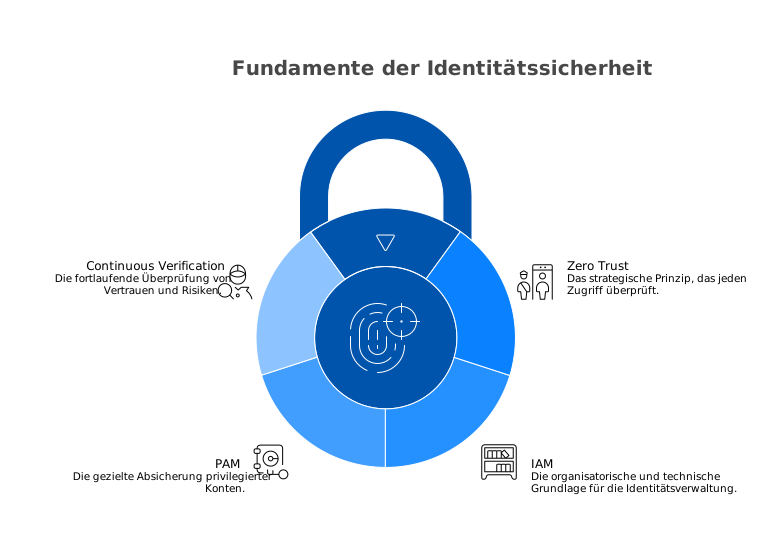
These four concepts only achieve their full potential when working together. Zero Trust provides the strategic security principle. IAM creates the organizational and technical foundation for managing identities and permissions effectively. PAM focuses on particularly sensitive accounts and ensures that privileged access does not become an uncontrolled vulnerability. Continuous Verification complements the architecture by enabling the continuous verification of trust and the early detection of dynamic risks.
If any of these building blocks is considered in isolation, gaps remain. Without IAM, Zero Trust often remains an abstract concept.
AccessKeeper from RISE: Enabling Modern Access Security
With AccessKeeper from RISE, COMPRISE offers an IAM system that helps companies meet modern security and governance requirements. This goes beyond the technical management of users and permissions to provide a controlled framework for identities, roles, and access decisions. Such a platform is of central importance, particularly in environments with high demands on data protection, compliance, and transparent processes.
AccessKeeper helps companies manage the transition from historically evolved authorization structures to a clearly defined and controllable security architecture. This not only reduces security risks but also improves auditability, traceability, and process quality. In the context of Zero Trust, PAM, and Continuous Verification, AccessKeeper thus becomes a strategic building block that brings together security, governance, and operational feasibility.
Conclusion: Less implicit trust, more controlled access
The demands on modern IT security are constantly rising. Hybrid infrastructures, cloud usage, external access, and regulatory requirements call for a model that organizes security not in a blanket manner, but in a differentiated and traceable way. Zero Trust, Identity & Access Management, Privileged Access Management, and Continuous Verification together form a robust framework for this.
With AccessKeeper from RISE, this framework can be implemented in practice. The system provides transparency regarding identities, supports controlled authorization processes, and forms the foundation for a security architecture in which trust is not assumed but systematically verified. In this way, user management becomes a strategic approach to robust, controlled, and future-proof access security.
Interested in this topic? - Get in touch with us!
Get in touch