Learn how Identity Governance & Administration (IGA) enhances an IAM system like AccessKeeper.
Reading time: 12 minutes
Today, companies face a growing challenge: Who has access to which systems—and are they authorized to do so? Identity & Access Management (IAM) has long served as the foundation for secure access control. However, with increasing regulatory requirements, more complex IT landscapes, and the call for greater transparency, IAM alone is often no longer sufficient. This is where Identity Governance & Administration (IGA) comes into play—as a strategic extension that takes an IAM system like AccessKeeper to a new level.
But what exactly distinguishes IGA from IAM? And how do companies specifically benefit when both disciplines work together?
IAM: The Operational Foundation
Identity & Access Management is the operational core of access management. An IAM system like AccessKeeper ensures that the right people have access to the right resources at the right time. Core functions typically include authentication (Who are you?), authorization (What are you allowed to do?), single sign-on (SSO), multi-factor authentication (MFA), and the management of user accounts and permissions throughout their entire lifecycle.
AccessKeeper as an IAM solution ensures that access rights are implemented correctly from a technical standpoint. It is the tool that opens and closes doors—quickly, reliably, and automatically.
The problem: IAM answers the question “Can this user access?” – but not the question “Should this user have access?”
IGA: Governance Meets Administration
Identity Governance & Administration takes a decisive step further. IGA supplements the operational capabilities of an IAM system with a strategic governance layer. It is no longer just about managing access, but about questioning it, reviewing it, and making it verifiably compliant.
A central component of IGA is access certification and recertification. In many companies, access rights are granted once—and then never reviewed again. Over months and years, employees accumulate permissions they no longer need: project access from the previous year, a test environment that was never decommissioned, a shared drive for a department they no longer belong to. IGA breaks this pattern by triggering regular recertification campaigns. In these campaigns, managers and application owners are systematically prompted to review the existing access rights for their teams and systems and to actively confirm or revoke them. This process ensures that the actual state of permissions continuously aligns with business needs.
Closely linked to this is the principle of Segregation of Duties (SoD). In every organization, there are combinations of rights that pose a significant risk if held by a single person. A classic example from the financial sector: Anyone authorized to create purchase orders should not simultaneously have the authority to approve the corresponding invoices. Without systematic monitoring, such toxic combinations often develop insidiously—for example, when an employee changes departments and retains old permissions while new ones are added. IGA automatically detects these conflicts, reports them to the responsible parties, and, when configured appropriately, can prevent dangerous combinations from arising in the first place.
Another key component is structured access request workflows. In many organizations, requests for new access rights still go through informal channels: an email to IT, a quick shout-out to the admin, a ticket without a clear approval process. IGA replaces these opaque methods with standardized request workflows. Every access request goes through defined approval stages—from the direct supervisor to the data or application owner, all the way through to automatic policy checks. Escalation paths kick in if approvals are not granted, and every step is documented in an audit-proof manner.
In addition, IGA enables centralized policy management that defines and enforces access policies across all connected systems. Companies define their compliance requirements—whether regulatory mandates, internal security policies, or industry-specific standards—as machine-readable rules. These are automatically checked with every authorization change, so that violations are detected in real time rather than only being noticed during the next audit.
All these processes ultimately converge into a comprehensive audit and reporting framework. IGA ensures complete traceability: Who received which rights and when? Who approved the access, and on what business grounds? Which recertifications were performed, and which rights were revoked in the process? This transparency is not only essential for external auditors but also provides internal decision-makers with the tools to make informed decisions about their company’s access landscape.
IGA in Practice: Three Typical Scenarios
Theory is one thing—but where does IGA demonstrate its value in everyday business operations? Three practical examples illustrate why identity governance has become indispensable for many organizations.
Scenario 1: The Creeping Proliferation of Permissions Following Internal Transfers
An employee starts at the company as a junior controller in the finance department and is granted access to the ERP system, the accounting software, and several shared finance drives. After two years, they move internally to product management. They receive new access rights for Jira, Confluence, and the PIM system—but their old finance permissions remain in place because no one actively thinks to revoke them. Another year later, he takes on a team lead role and receives additional approval rights.
The result: A single employee now has permissions from three different roles—including a toxic combination of financial access and approval authority. Without IGA, this risk remains invisible. With an IGA solution, a recertification campaign would have identified the outdated financial rights when the employee changed departments, and a SoD check would have automatically flagged the critical combination of rights.
Scenario 2: The external auditor comes knocking
A financial services provider is facing its annual audit by the BaFin supervisory authority. The auditors require proof that access rights to critical systems are regularly reviewed, that no unauthorized combinations of rights exist, and that every assignment of permissions was approved in a traceable manner. Without IGA, a weeks-long process of sifting through Excel lists, email threads, and manual documentation begins—with the risk that gaps will become apparent.
With an IGA solution, however, the system delivers a complete audit trail at the click of a button: all recertification cycles with results, all SoD conflicts with their resolution, all access requests with approval history. What takes weeks without IGA and creates uncertainty becomes structured, verifiable evidence available at any time.
Scenario 3: Fast Onboarding Without Losing Control
A growing technology company hires 50 new employees each quarter. Depending on their role, each person needs access to a combination of cloud services, internal tools, code repositories, and customer databases. The IAM system, such as AccessKeeper, automatically provisions accounts based on role profiles—quickly and efficiently.
But what happens if a new sales employee is accidentally assigned a developer role profile and thereby gains access to source code and production systems? IGA catches such errors by automatically checking, with every role assignment, whether the resulting permissions align with the defined policies. If the assignment deviates, the process is halted and an approval workflow is triggered before access is actually granted. This keeps onboarding fast—but controlled.
The Difference in a Nutshell
The difference between IAM and IGA is best understood through their respective perspectives.
IAM is operational and technically oriented. It addresses the question of how identities and access rights are managed technically. IAM provides connectors to target systems, synchronizes user accounts, and enforces permissions. The focus is on efficiency and automation in day-to-day operations.
IGA, on the other hand, is strategic and governance-oriented. It asks whether access rights are appropriate, compliant, and verifiable. IGA is aimed at compliance officers, auditors, and management. The focus is on risk minimization, transparency, and regulatory compliance.
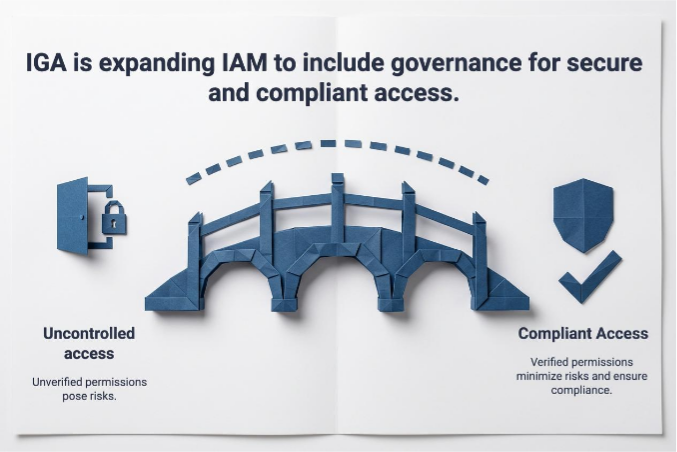
A helpful analogy: IAM is the lock on the door. IGA is the process that determines who is allowed to receive a key, how often key issuance is reviewed, and whether the issuance rules comply with regulations.
How IGA Specifically Enhances a System Like AccessKeeper
When IGA is integrated with an established IAM system like AccessKeeper, the result is a combination that unites operational strength with strategic control.
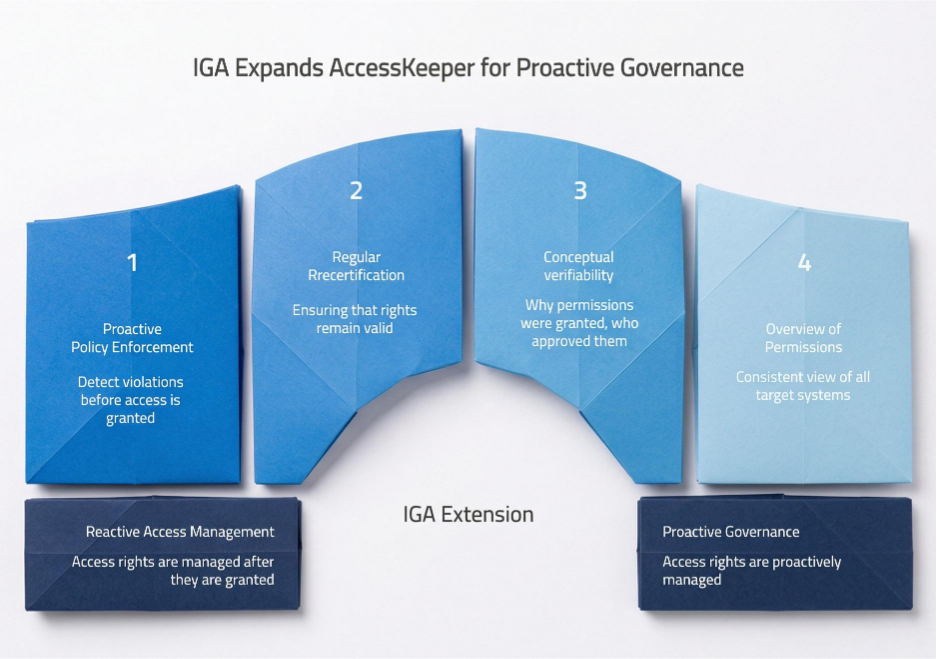
From reactive to proactive: AccessKeeper manages access rights efficiently. With an IGA extension, however, the entire system can detect in advance when an authorization request violates defined policies—even before access is granted.
From Provisioning to Governance: AccessKeeper provisions and revokes user accounts. IGA complements this with regular recertification campaigns that ensure that rights granted once remain valid in the long term.
From Management to Traceability: While AccessKeeper logs who has which rights, IGA provides the context—why were the rights granted, who approved them, and are they in line with corporate policies?
From individual systems to the big picture: IGA aggregates permission information across all target systems connected to AccessKeeper, creating a unified view of the entire permission landscape—complete with risk assessments and recommendations for action.
Why Companies Should Act Now
Regulatory requirements are constantly increasing. Whether it’s the GDPR, NIS2, BAIT, VAIT, or industry-specific guidelines—regulatory authorities and auditors increasingly expect companies not only to manage access rights but also to be able to demonstrate their appropriateness.
At the same time, complexity is growing: hybrid cloud environments, SaaS applications, and decentralized work models mean that a pure IAM system reaches its limits when it comes to maintaining an overview of all permissions and ensuring their compliance.
The combination of a powerful IAM system like AccessKeeper and an IGA extension creates exactly the bridge between operational efficiency and strategic control that modern companies need.
Conclusion
IAM and IGA are not competitors—they are partners. An IAM system like AccessKeeper provides the strong operational foundation for access management. IGA builds on this and adds the crucial governance perspective: transparency, compliance, and risk control.
Companies that invest in IGA today not only lay the groundwork for successful audits but also strategically position themselves for a future in which verifiable access control is no longer a “nice-to-have”—but a business-critical necessity.
Interested in this topic? - Get in touch with us!
Get in touch