The Convergence of BPM and DMS: Why Processes and Documents Go Hand in Hand
Two Worlds, One Goal
Anyone who works in a company is familiar with this scenario: On one side, there is a document management system (DMS) where contracts, invoices, and reports are stored. On the other side, there is a BPM (Business Process Management) platform that controls workflows, assigns tasks, and coordinates approvals. At their core, both systems pursue the same goal—they aim to bring order to day-to-day operations. Nevertheless, in many organizations, they operate in isolation from one another.
The result is data silos, manual handoffs, and the infamous question: “Where is the latest version?” The convergence of BPM and DMS is not a technical gimmick, but a strategic necessity.
Why the separation is no longer appropriate
Documents are the fuel of business processes. An incoming invoice triggers an approval workflow. A draft contract goes through review cycles. A vacation request is digitally signed and archived. In each of these cases, the document is not merely an attachment but a central component of the process.
When BPM and DMS operate separately, typical problems arise: employees copy files back and forth between systems, version conflicts pile up, and traceability—especially with regard to compliance—suffers significantly. An integrated approach eliminates these inefficiencies because documents are available where the process needs them, and processes start where a document is received.
What convergence means in practice
The convergence of both disciplines manifests itself in several dimensions:
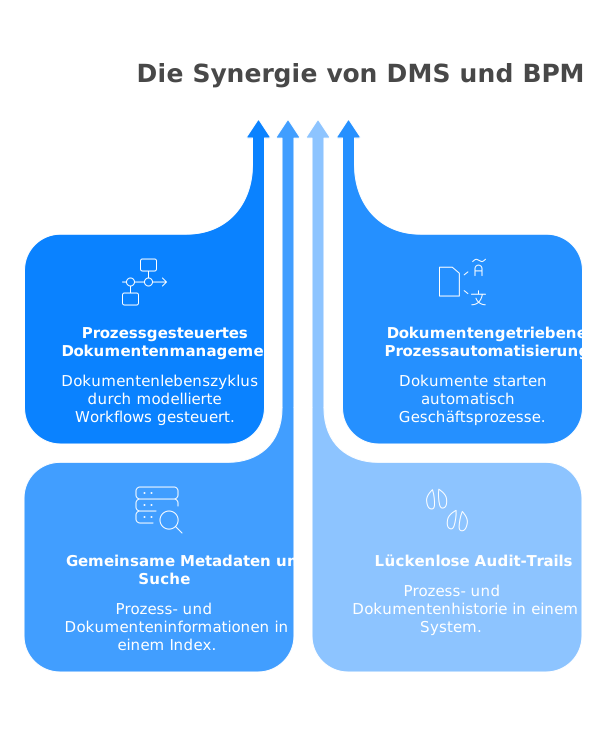
Process-driven document management means that a document’s lifecycle—from creation through approval to archiving—is controlled by a modeled workflow. There are no more loose files lying “somewhere”; every document has a clearly defined place in the process.
Document-driven process automation flips the perspective: The receipt of a specific document type automatically triggers a business process. A scan of an incoming invoice triggers invoice verification; an uploaded draft contract initiates legal review.
Shared metadata and search ensure that process information (Who approved it and when?) and document information (Which version? What document type?) converge in a unified index. Employees no longer search across two systems but find everything in one place.
Seamless audit trails emerge almost automatically when process history and document history merge into a single system. For regulated industries—from finance to the pharmaceutical sector—this is a huge advantage.
The Role of Open Standards
A key factor in the success of convergence is the use of open standards. BPMN 2.0 (Business Process Model and Notation) has established itself as the industry standard for process modeling. On the document side, formats such as PDF/A for long-term archiving and open interfaces (REST APIs, CMIS) play a central role. When both worlds are based on open standards, systems can be integrated more easily—regardless of the vendor.
RISE-Workflow: A Modern Approach for Process-Driven Organizations
At this point, it’s worth taking a look at RISE-Workflow, an open-source platform for workflow and process automation. Operaton—derived from the proven Camunda 7 codebase—offers several features that make it particularly interesting in the context of BPM-DMS convergence.
Openness and Extensibility: With RISE-Workflow, companies have full control over the source code. Those requiring deep integration with a DMS—whether via REST interfaces, message queues, or custom connectors—can implement this without vendor lock-in.
BPMN-native execution: RISE-Workflow executes BPMN 2.0 models directly. This means that the processes modeled by business departments actually run exactly as they were designed. Document-related steps—review, approval, archiving—can be mapped directly within the process model as service tasks or user tasks.
Lightweight Architecture: Unlike some enterprise suites that require an entire ecosystem, RISE-Workflow can be operated in a lean manner. It can run as an embedded engine within an existing application or as a standalone server. This makes integration into existing IT landscapes—including existing DMS solutions—significantly easier.
Community and Ecosystem: Users benefit from regular updates, shared knowledge, and a growing number of integrations. Anyone needing a connector to a specific DMS will often find preliminary work already done within the Operaton community—the solid open-source foundation of RISE-Workflow.
Cost Transparency: Especially for mid-sized companies, the licensing issue with BPM platforms is a critical factor. RISE-Workflow significantly lowers the barrier to entry and allows budgets to be invested more heavily in the actual integration and process optimization rather than in licensing fees.
Practical Steps for Integration
Anyone looking to drive the convergence of BPM and DMS within their own company should take a pragmatic approach. A proven approach begins with identifying document-intensive processes—such as in contract management, invoice processing, or human resources. These processes are modeled in BPMN, and document interactions (upload, review, versioning, archiving) are mapped as explicit process steps.
In the next step, the technical bridge is built: The BPM engine—such as Operaton—communicates with the DMS via APIs. Documents are referenced, not copied. Metadata flows bidirectionally. And the process status is visible in the DMS at all times, just as the associated document can be retrieved within the process context.
Conclusion: Integration Instead of Siloed Solutions
The convergence of BPM and DMS is not a distant future scenario, but a development that is already taking place today. Companies that think of processes and documents together reduce friction, improve their compliance, and create a better work experience for their employees.
Open platforms like Operaton make it possible to implement this integration step by step and without vendor lock-in. The key lies not in a monolithic all-in-one system, but in an intelligent connection of specialized components—driven by cleanly modeled processes and supported by open standards.
The question is no longer whether BPM and DMS will converge, but how quickly your company will take this step.
This article serves as a guide for decision-makers and IT managers who wish to modernize their process and document landscape.
Interesse am Thema? - Reden Sie mit uns!
Get in touch