Trends in IT monitoring: Towards unified transparency
Anyone walking into a typical IT department today is unlikely to find a single monitoring console. Instead, network dashboards run alongside server alerts, and cloud metrics alongside application traces – each tool provides its own slice of the truth. The result: information exists in silos, troubleshooting becomes a puzzle, and true transparency remains a promise.
This is precisely where a paradigm shift is emerging. The trend is clearly moving towards Unified Observability – a unified view of the entire IT landscape. In this article, we explore what this means in concrete terms and which developments are paving the way for it.
The proliferation of tools as the underlying problem
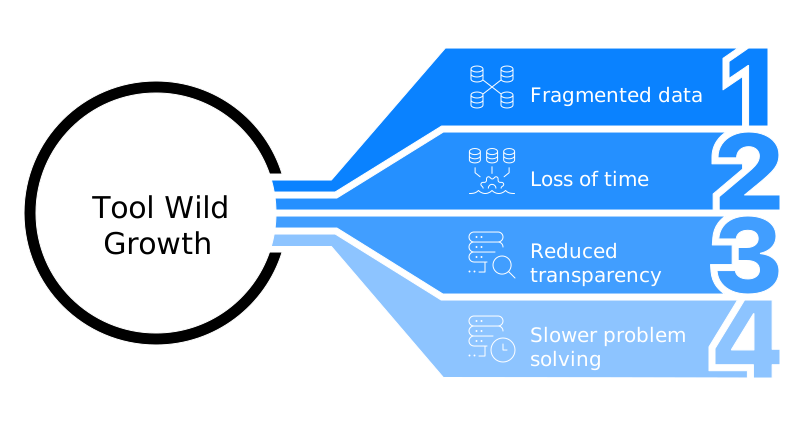
Monitoring environments that have evolved over time are not the exception but the norm. One solution for the network, one for the servers, a third for the cloud – and perhaps even a separate dashboard for each business application. Studies show that, on average, companies run between six and fifteen different monitoring tools in parallel.
The result is paradoxical: although more data is being collected than ever before, actual transparency is declining. Teams spend valuable time manually collating information from different sources, rather than proactively solving problems. At COMPRISE, we encounter this pattern in almost every client project – and it is one of the reasons why we have been relying on cross-vendor integration approaches for years.Anyone walking into a typical IT department today is unlikely to find a single monitoring console. Instead, network dashboards run alongside server alerts, and cloud metrics alongside application traces – each tool provides its own slice of the truth. The result: information exists in silos, troubleshooting becomes a puzzle, and true transparency remains a promise.
This is precisely where a paradigm shift is emerging. The trend is clearly moving towards Unified Observability – a unified view of the entire IT landscape. In this article, we explore what this means in concrete terms and which developments are paving the way for it.
The proliferation of tools as the underlying problem
Monitoring environments that have evolved over time are not the exception but the norm. One solution for the network, one for the servers, a third for the cloud – and perhaps even a separate dashboard for each business application. Studies show that, on average, companies run between six and fifteen different monitoring tools in parallel.
The result is paradoxical: although more data is being collected than ever before, actual transparency is declining. Teams spend valuable time manually collating information from different sources, rather than proactively solving problems. At COMPRISE, we encounter this pattern in almost every client project – and it is one of the reasons why we have been relying on cross-vendor integration approaches for years.
Five Trends Driving Change
1. Convergence of Monitoring, Logging, and Tracing
The traditional distinction between infrastructure monitoring, log management, and application performance management is dissolving. Modern platforms bring all three disciplines together under one roof. The goal: to make it possible to understand what happened, where it happened, and why from a single interface.
For businesses, this means fewer context switches, faster root cause analysis, and a significantly reduced Mean Time to Resolution (MTTR).
2. AI-powered anomaly detection and AIOps
Static thresholds reach their limits in dynamic cloud environments. AIOps approaches use machine learning to learn normal behavior, detect deviations early, and establish correlations between seemingly unrelated events.
The added value lies not only in faster detection but, above all, in the reduction of alert noise. Instead of sifting through hundreds of individual alerts, teams receive prioritized, contextualized incidents—a topic that is also playing an increasingly central role in COMPRISE consulting practice.
3. Observability as Code
Infrastructure as Code has long been established. Now monitoring is following suit. Observability as Code means that dashboards, alerts, and SLO definitions are versioned, reviewed, and automatically rolled out—just like application code. This makes monitoring configurations reproducible, auditable, and consistent across teams.
4. End-to-End View of Hybrid Environments
On-premises, private cloud, public cloud, edge—most companies operate hybrid infrastructures. The challenge lies in bringing these heterogeneous environments together into a unified view without losing the depth of analysis.
Solutions such as the monitoring and integration platforms from the COMPRISE portfolio address precisely this need: They create a vendor-neutral framework around existing tools and consolidate their data into a central interface. This transforms fragmented monitoring into true end-to-end transparency.
5. Business Service Monitoring
IT metrics alone tell only half the story. The trend is toward linking technical metrics with business processes. Instead of “CPU utilization at 92%,” the message becomes “The online checkout process is impaired; estimated revenue loss: €4,200 per hour.” It is this linkage that makes IT monitoring a strategic tool at the executive level.
Unified transparency is not a luxury, but a necessity
All five trends point in the same direction: away from isolated data silos, toward a consolidated, context-rich holistic view. This is not purely a technical issue. Unified transparency changes how IT teams work, how quickly incidents are resolved, and how effectively IT can communicate its performance to the business.
The path to achieving this is rarely a big-bang project. Rather, it involves consolidating step by step, protecting existing investments, and simultaneously keeping a clear target architecture in sight.
This is precisely the pragmatic approach COMPRISE takes in its projects—from the initial assessment through tool selection to the sustainable handover of operations.
Conclusion
IT monitoring is at a turning point. Those who continue to rely on fragmented tool silos risk blind spots, slow response times, and a growing gap between IT and the business. Unified transparency—driven by platform convergence, intelligent automation, and a clear strategy—is becoming a key differentiator.
The first step? An honest assessment of your own monitoring landscape. If you’re looking for support with this, the experts at COMPRISE are happy to assist.
Interested in this topic? – Get in touch!
Get in touch